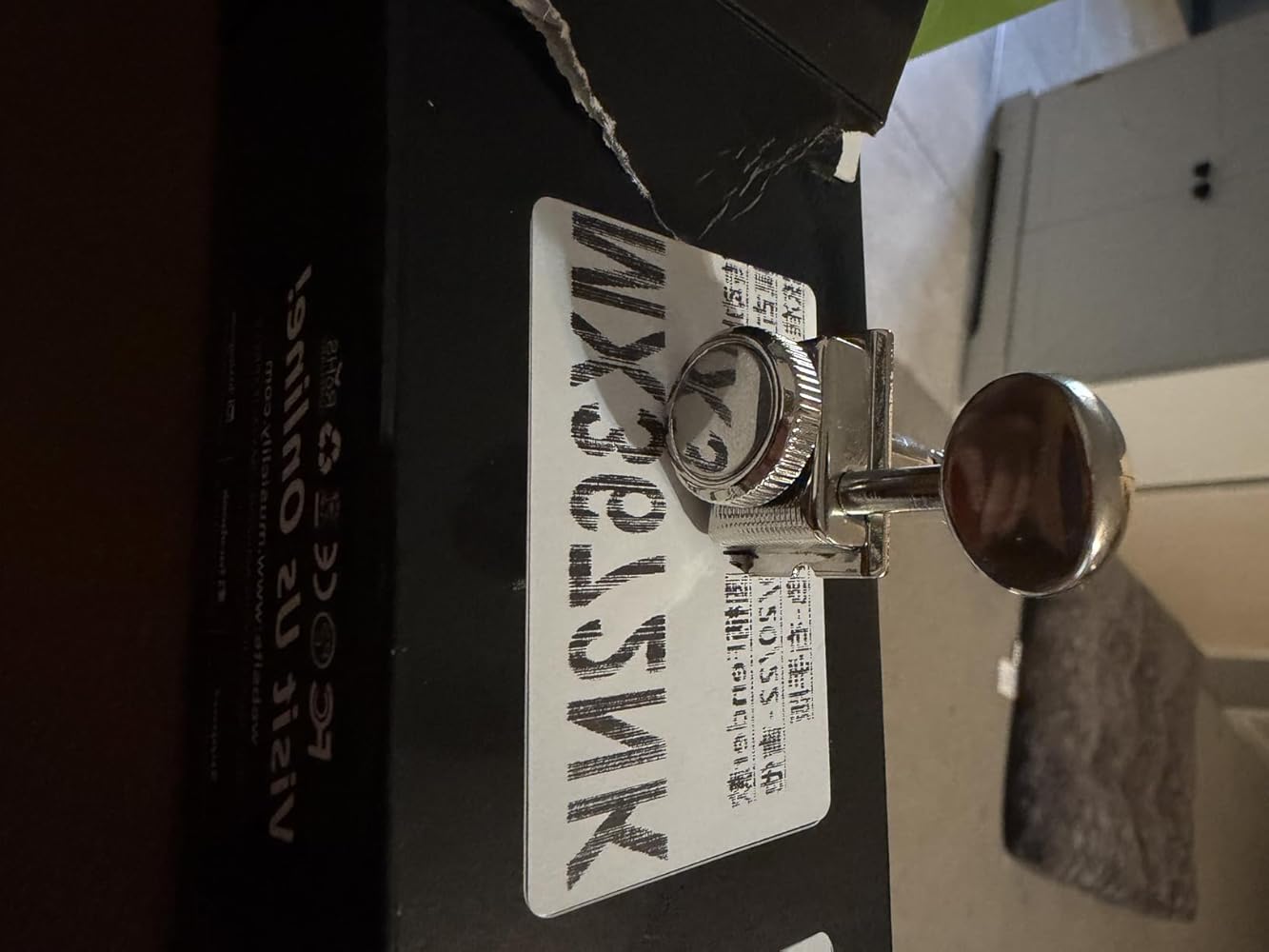
These are 6 inline old school classic looking locking tuners. The finish is nicely done. Of course the nice feature of these is that they are locking tuners. So you cut the string to just stick out past the hole in the peg, lock the string with the locking thumb screw and tune the string without having to wind the string around the peg multiple times.However, they are not initially completely uniform in friction during tuning. Each full revolution of the tuner, so 18 full turns of the tuning thumb screw results in varying degrees of friction turning the thumb screw from less friction to more friction, easier to harder, and is consistent based on where in the full 360 degree position of the peg is. On 4 of the 6 the higher friction area did loosen up a bit with repeated use. On 2 of the 6, the friction got worse with both of them getting more difficult to turn. Those 2 tuners that got more difficult to turn with use developed backlash on the tuning thumb screw.The backlash on 2 of these is disappointing. The increased friction on the 2 tuners with use is also disappointing. Binding and backlash seem to be common with inexpensive turners. However, because these are locking tuners, the increase in friction can be somewhat mitigated. By positioning the post just before the middle of the area without increased friction, the friction area can be avoided because when tuning, you only turn the post about 180 degrees or less to tune the string. The backlash is only going to be apparent when you loosed the string. While tuning the string to tension the backlash doesn’t matter. So even though the friction is not uniform, it is in the same spot and can be mitigated due to these being locking tuners and the backlash, although not optimum, doe not impede tuning since you always loosen the string and then tune to tension.More important to me in inexpensive tuners is that they are not gritty, which definitely detracts from precise tuning of the string to tension. None of these are gritty, they are smooth tuning. So in my opinion, those these do not perform like $100 tuners, because they are much less expensive, for inexpensive tuners they tune just fine because they are not gritty and although there is a little backlash and extra friction in 2 of the 6, that doesn’t really impede precise tuning and just seems to be a common trend in inexpensive tuners. Also being 18:1 ratio tuners, they are more precise than a lower ratio tuner.I gave these 4 stars instead of 5 due to the non-uniform friction and backlash on 2 of the 6 tuners but as stated above, that can be worked around if you don’t want to spend $100 for better tuners. Let’s face it, most people with a $200 or $300 guitar are not going to spend $100 on new tuners. These will get the job done and locking tuners are a game changer.